I am impressed with your work <Léthé>,
When did you start to shoot it? And what made you start
to do this series?
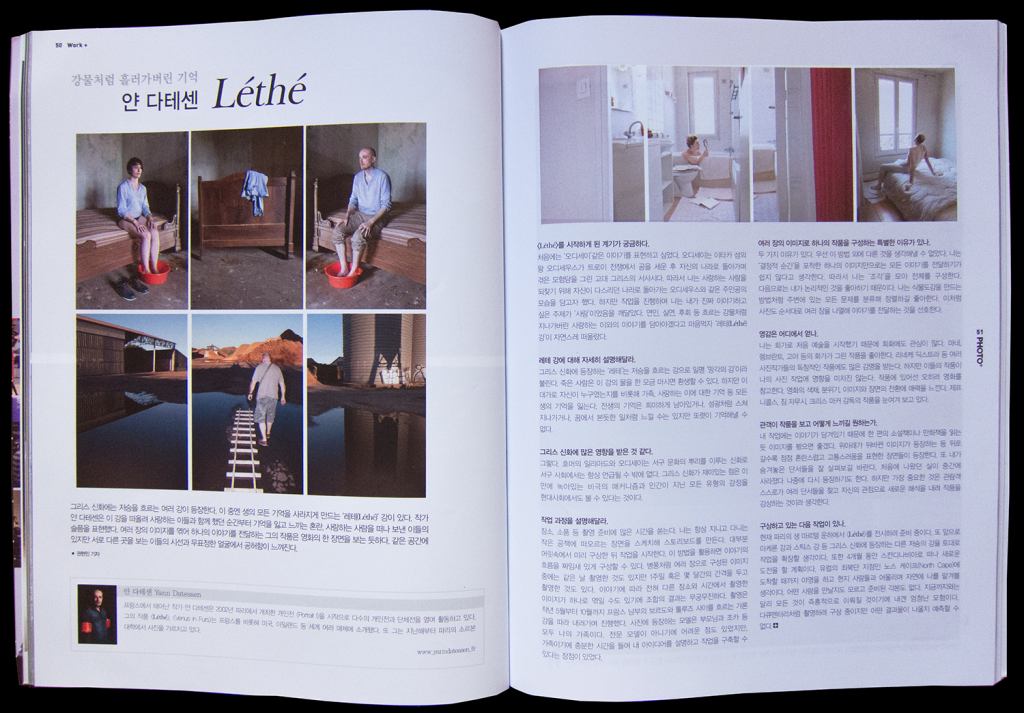
J’ai réalisé cette série entre Mai et Octobre 2013,
en descendant le fleuve de la Garonne dans le sud
de la France, entre les villes de Bordeaux et Toulouse.
Au départ, je voulais aborder l’idée d’odyssée,
une dérive, des tourments, des épreuves, peut-être réaliser
un Ulysse (à bien y regarder on peut d’ailleurs
retrouver un cyclope, des Lotophages, une Circé, une Calypso,
des méduses, la construction d’Ithaque…) quelqu’un qui
cherche à revenir chez lui, ou qui cherche à retrouver
quelqu’un qu’il a aimé.
Puis, au fur et à mesure que j’avançai dans mon projet,
j’ai compris que je voulais vraiment parler « d’amour »,
du couple, de l’oubli, des regrets, de ce temps « qui passe
sous les ponts », comme l’eau, comme le Léthé…
I produced this series between May and October 2013 whilst
descending the Garonne river in the South of France, between
the cities of Bordeaux and Toulouse. At first I wanted to
explore the idea of an odyssey, a dérive, turmoil,
tests … Perhaps to conjure Ulysees (if you look
closely you can even find a cyclops, some Lotus-eaters,
Circe, Calypso, mermaids, the création of Ithaca …),
someone who is seeking to return home, or to find again
someone he once loved.
Then bit by bit as I progressed with my project, I understood
that what I really wanted to talk about was love: the couple,
loss, regrets, the time that ‘flows under the bridge’,
like water, like the Lethe.
How can you make a piece of work? I am curious about
the whole process of your work.
J’ai besoin de beaucoup de préparation avant me lancer dans
la prise de vue : repérages, recherches d’objets,
documentations sur les thèmes que je vais traiter.
Je réfléchis assez longtemps à l’histoire que je veux raconter,
en réalise plusieurs story-board, des scénarios que je dessine
sur des petits cahiers qui me suivent partout le temps
d’accoucher de ma série. Bien sûr je me laisse de-ci de-là
quelques libertés mais en général j’ai en tête 80% des visuels
que je vais effectuer. Quand je me sens prêt, je réunis mes
modèles et tente de me rapprocher au plus près de ce que j’ai
sur ces petits cahiers…
Grâce à cette méthode, je peux mettre en place la progression
de mon histoire, anticiper l’évolution de mes personnages,
je peux tisser le lien qui va « unir » toutes les images.
D’un pur point de vue formel, cela me permet aussi d’aiguiser
ma réflexion sur l’image elle-même : j’expérimente des
associations nouvelles, ou tente des cassures, je choisis,
je sais à l’avance si les images de mes polyptiques vont être
prises dans un même « espace-temps » (avec seulement quelques
secondes de décalage), ou si elles vont provenir d’un même
lieu mais avec des semaines, parfois des mois, d’écarts
entre elles… Selon ce qu’il y à raconter, ces images
peuvent aussi naître d’un endroit et d’une époque
complètement différents : les combinaisons sont infinies.
I need a long period of preparation before it comes to
shooting: location hunting, research on objects, and
literature on the themes that I wish to address. I think
about the story I want to tell for quite some time by
creating storyboards and scenes that I draw in little books
that follow me all the time as I bring my series to life.
Of course I leave myself some freedom here and there but
in general I have 80% of the visuals in my head before
I create them. When I feel ready, I bring together my
models and I attempt to get as close to what I have in
the little notebooks.
Thanks to this method, I can organize the development of
my story, anticipate the evolution of my characters and
weave together the links that will “unite” all the images.
From a purely formal point of view this enables me to sharpen
my reflections of the image itself: that is whether the images
for my polyptychs will be shot in the same “space-time”
(within a few seconds of each other) or if they originate
from the same place but are separated by weeks, sometimes
month-long gaps. Depending on what is to be told, these images
may also be born from a completely different place and period:
the combinations are infinite.
Who are the models? Are they professional models?
Pour cette série, les modèles sont des membres de ma famille.
Père, mère, sœur, nièce… Pour d’autres projets, je peux
travailler avec des professionnels mais je n’en retire pas
autant de « substances ».
For that series, the models are members of my family:
my father, my mother, my sister, my niece. For other projects
I might work with professionals but I find it’s rarely
possible to draw out as much ‘substance’ from them.
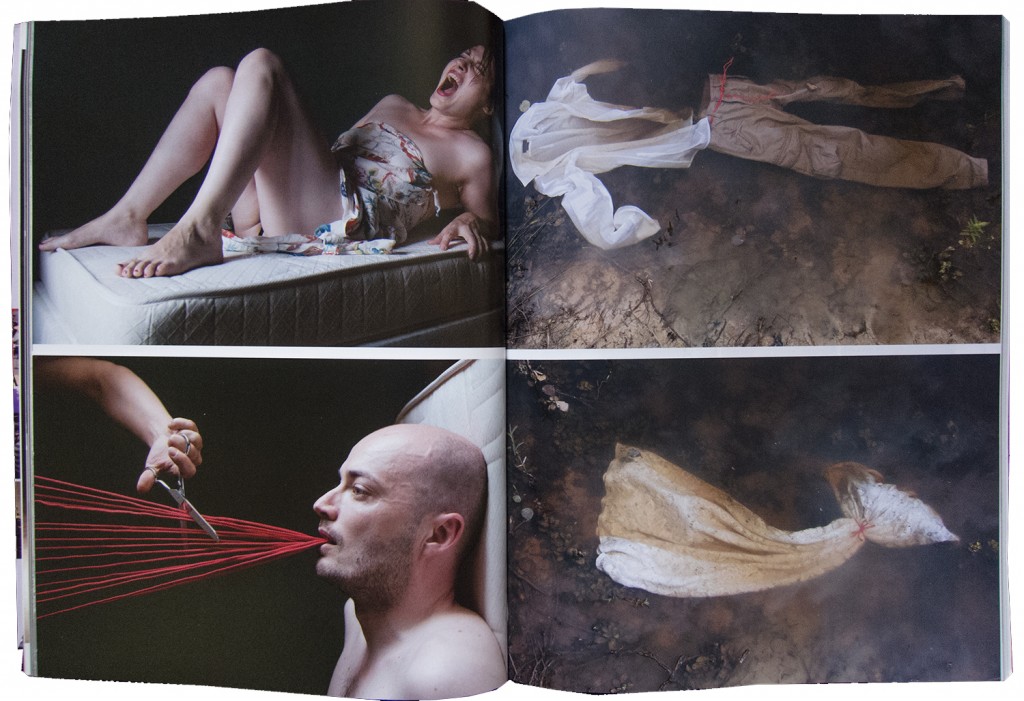
One piece of work consists of two, three or four images
from different angles. Can you explain the reason why
you work like that?
Pour deux raisons essentiellement: La première est que
je ne sais pas faire autrement! Ma personnalité, mon
éducation à l’image, la façon dont mon corps, malgré moi,
tente d’exorciser une certaine panique du vide, du silence,
du manque, m’ont conduit très vite à procéder de la sorte.
Je n’ai jamais vraiment réussi à me tenir à une unicité,
à tout mettre dans une seule et même image comme pour ce
fameux instant décisif. J’ai cette nécessité de
collecter du fragment, le fragment : « un morceau de chose
qui a été cassé, séparé de son tout ». Comment retrouver
ce « tout » ? Une seule découpe ? Une seule empreinte du
réel ? Une seule image suffit-elle vraiment ? Peut-être pas.
La seconde raison est que j’aime rationnaliser, et pour cela
il faut trouver de la matière tout autour de soi, puis la
classer, l’ordonner, la nommer, sur le principe de l’herbier,
je cherche à contrarier le désordre, je me dis que mettre
plusieurs indices « à plat », sur une table, m’aidera peut-être
à mieux comprendre et résoudre l’énigme…
For two reasons essentially. The first is that I don’t know
any other way to work! My personality, my education with
regards to the image, the way in which my body (in spite
of itself) attempts to exorcise a type of panic of emptiness,
because of silence, absence, all these things very quickly
drove me proceed in this way. I never really managed to
constrain myself to ‘uniqueness’, to putting everything
in one image alone as with the famous
decisive moment. I have that necessity to collect
fragments … the fragment, “a pièce of something
that has been broken, separated from everything”.
How can this ‘whole’ be found? A single shot? A solitary
imprint of the real? Is one image really enough?
Perhaps not.
The second reason is that I like to rationalize and for that
you have to locate the matter all around yourself, then to
classify it, order it, and name it according to the principal
of a herbarium. I seek to go against the disorder. I say to
myself that several clues ‘laid out’ on a table will perhaps
help me to better understand and resolve the enigma …
What is the most important thing when you take a photograph?
Ma façon de concevoir la photographie n’est finalement
pas très photographique…. Comme je procède par associations
d’images et non pas par image unique, comme je bondis de série
en série sans me soucier de faire « une belle image », du coup
la prise de vue n’est pas une chose essentielle pour moi,
je me sens très éloigné du concept d’instant décisif,
et il est clair que ma famille est plus celle des plasticiens.
A chaque fois, je cherche à retranscrire un « univers » complet,
une « continuité », un corpus d’images dans lequel
tout est « lié », et puis : j’ai tellement préparé mon affaire
avant d’appuyer sur le déclencheur que ce moment là n’a rien
de « sacré » pour moi.
My way of conceiving of photography is ultimately not very
photographic. Because I proceed through associations of
images and not by a unique image, because I jump from one
series to another without worrying about creating “a beautiful
image”, the shooting is not something essential for me.
I feel very removed from the concept of the
decisive moment and without doubt my family is that
of the plasticians. I always seek to transcribe a complete
“universe” a “continuity”, a corpus of images in which
everything is “linked”, and then I’ve prepared my venture
so much prior to releasing the shutter that there is nothing
particularly “sacred” in that moment for me.
Do you have any artists or things that inspire you?
Bien sûr, je ne peux caché mon amour de la peinture :
Manet, l’école viennoise, les nabis, Rembrandt, Goya…
j’ai débuté mon parcours artistique comme peintre et beaucoup
de choses en sont restées.
Photographiquement parlant, même s’il y a énormément
d’auteurs dont j’admire le travail (Rineke Dijkstra en tête),
je ne peux pas vraiment dire qu’un univers photographique
en particuliers influence directement ma démarche.
En fait, je me sens beaucoup plus proche du cinéma,
j’y trouve des couleurs, des atmosphères, et surtout
des transitions d’images et des séquençages qui me fascinent;
à ce titre des gens comme Jeff Nichols, Jim Jarmusch,
et bien sûr Chris Marker et ses photos-Romans,
sont des références pour moi.
Enfin, si je devais mettre de la musique sur mes images,
vraisemblablement les pianistes Erik Satie et Chilly Gonzales
seraient en tête de liste : comme ils accompagnent tous mes
projets depuis des années, j’ai l’impression de leur devoir
beaucoup.
Of course, I can’t hide my love for painting: Manet,
the Vienna school, Les Nabis, Rembrandt, Goya…
I started my artistic journey as a painter and I’ve retained
a great deal from this.
Even if there are lots of auteurs whose work I admire in
terms of photogtraphy, (Rineke Dijkstra comes to mind)
I can’t really say that a particular photographic universe
influences my approach. In fact, I feel much closer to the
cinema. I find in it colors, atmospheres, and especially
transitions of images and sequences that fascinate me.
To this end people like Jeff Nicholls, Jim Jarmusch and
of course Chris Marker and his photo-romans
are references for me.
Finally, if I had to put music over my images in all
likelihood the pianists Erik Satie and Chilly Gonzales
would be at the top of my list. I feel that I owe them
a lot because they have accompanied all my projects
for many years.
What do you want people to get from your photographs?
J’aimerais, comme pour un bon film, que la première vision
de ma série laisse une impression tenace, qu’elle reste là,
plusieurs jours, infuse en-dedans. Puis, qu’on ait envie
d’y revenir un peu plus tard, et qu’à ce moment-là,
on y découvre de nouvelles choses, des détails que je cache
dans les recoins, et qu’ainsi d’autres histoires puissent
commencer.
I would like the first viewing of my series to leave
a lingering impression that endures for several days,
percolating inside the viewer like after watching a good film.
Then I hope that it leaves them with the desire to return
to it a little later and that at that moment they discover
something new, details hidden in the recesses, which enable
new stories to flow.
What are you working on now and what are you planning
to work on in the future?
A l’heure d’aujourd’hui, j’essaye de faire exposer mon
« Léthé » le long des écluses du canal-st-Martin à Paris.
Pour mon prochain projet, je me lance un défi. Un défi humain
et esthétique. Je vais partir 4 mois en Scandinavie, dormir
dehors presque tous les soirs, partir à l’aventure,
rencontrer des gens et me perdre dans le sauvage jusqu’au
Cap Nord (le point le plus septentrional d’Europe).
Je parle de défi esthétique parce que ma façon de fabriquer
de l’image est tout sauf « spontanée », et là-bas je n’aurais
pas de modèles connus, pas de scénarios préparés, il faudra
appliquer mon vocabulaire aux aléas du style documentaire
et je ne sais pas ce que cela va donner…
At this very moment I’m trying to get my ‘Léthé’ exhibited
along the tide gates of the Canal St. Martin in Paris.
For my next project, I have given myself a challenge both
human and aesthetic. I’m going to Scandinavia for four
months. I will be sleeping outside most nights, departing
on an adventure, meeting people and losing myself in the
wild until I reach the North cape (the northern most point
in Europe). I describe it as a challenge because my approach
to creating images is everything but ‘spontaneous’,
and I won’t have any known models there, no prepared
scenarios. I will have to apply my vocabulary to the chance
of the documentary style and I don’t know what the outcome
will be …